Understanding the Main Tree Surgery Services
Tree surgery covers a range of specialist services designed to manage the health, structure, size and condition of trees. The appropriate method depends on the tree species, maturity, location and reason for carrying out the work.
Some trees require light pruning to remove small defects, while others need significant reshaping, sectional dismantling or complete removal. For property owners in Nailsea, Bristol, a professional assessment helps identify the most suitable form of tree surgery without removing more growth than necessary.
Crown Reduction
Crown reduction decreases the overall height or spread of a tree by shortening selected branches throughout the canopy. Cuts are made back to suitable growth points to retain a balanced, natural shape.
This method may be appropriate when a tree:
- Has become too large for its surroundings
- Contains long or heavily extended limbs
- Is placing excessive shade over a garden
- Has an unbalanced canopy
- Requires greater clearance from nearby features
- Is exposed to substantial wind movement
Crown reduction requires careful planning. Removing too much growth or making unsuitable cuts can weaken the tree and encourage poor-quality regrowth.
Crown Thinning
Crown thinning selectively removes smaller branches from throughout the outer canopy. Unlike crown reduction, it does not significantly alter the tree’s overall dimensions.
The purpose is to create a more even branch structure and allow additional light and air to pass through the crown. It may also reduce the density of a particularly crowded canopy.
Branches should be removed evenly so that the tree retains its natural balance. Excessive thinning can expose previously sheltered limbs and reduce the tree’s ability to produce energy.
Crown Lifting
Crown lifting involves removing or shortening lower branches to increase the clearance beneath a tree. This can improve access, open sightlines and prevent branches from obstructing parts of a garden.
It may be useful where lower growth interferes with:
- Paths and driveways
- Garden seating areas
- Lawns and planted borders
- Property access
- Routine garden maintenance
The amount of work must suit the age and structure of the tree. Removing large lower limbs from a mature specimen can create substantial wounds and affect stability, so the work should be carefully assessed.
General Tree Pruning
General pruning removes specific branches to improve the tree’s structure, appearance or suitability for its location. This may include crossing, rubbing, damaged or poorly positioned growth.
Pruning can also guide the development of younger trees. Correcting structural weaknesses at an early stage may reduce the need for more extensive work as the canopy matures.
Professional pruning considers where each cut is made and how the tree is likely to respond. Randomly shortening branches can produce weak regrowth and spoil the natural form.
Deadwood Removal
Deadwooding is the removal of dead, dying or detached branches from the canopy. Dead branches no longer contribute to healthy growth and may become less secure as they deteriorate.
This service is particularly relevant where branches overhang frequently used parts of a property. A tree surgeon can identify deadwood while checking whether its presence is isolated or associated with wider decline.
Not every dead twig requires intervention. The size, height and position of the branch help determine whether removal is appropriate.
Tree Felling
Tree felling removes the entire tree at ground level. It is usually considered when the tree is dead, seriously damaged, structurally unsuitable for its location or cannot be managed effectively through pruning.
Where there is sufficient clear space, a tree may sometimes be felled as a complete unit. In confined gardens, this may not be possible because of buildings, boundaries, planting or limited access.
Felling should follow a careful assessment of the tree’s condition, lean, weight distribution and surroundings.
Sectional Dismantling
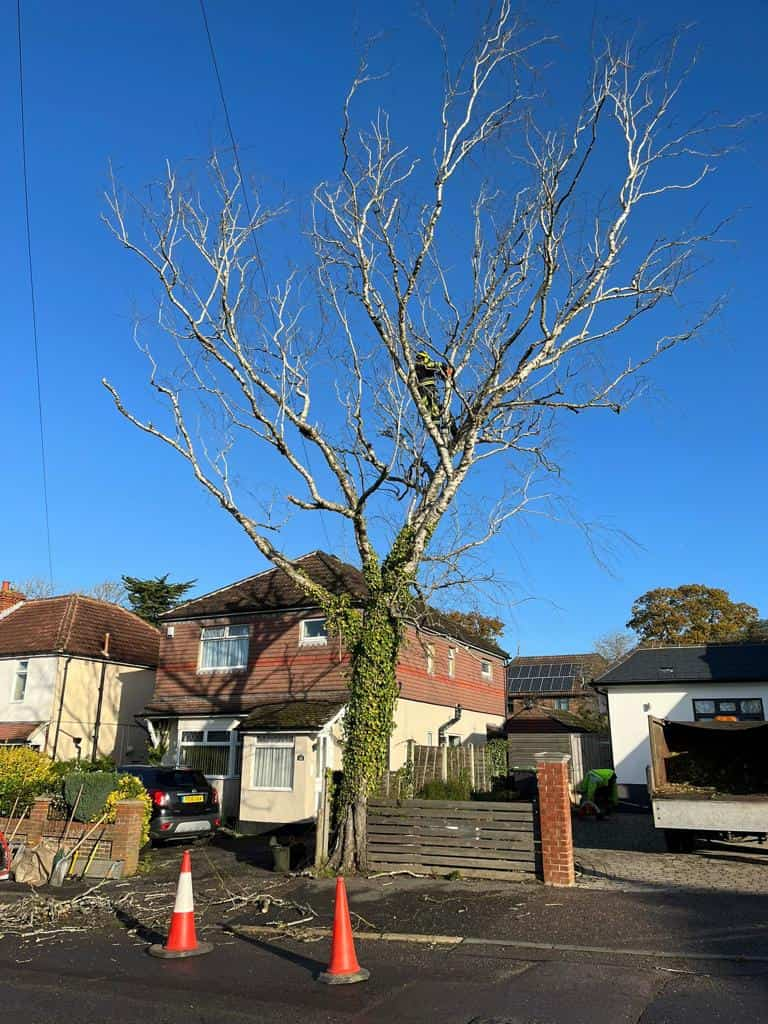
Sectional dismantling is a controlled method of removing a tree in smaller pieces. A tree surgeon works through the crown and trunk in stages, lowering sections where necessary to protect the surrounding area.
This method is commonly used when a tree stands close to:
- Buildings
- Fences and walls
- Sheds or garden structures
- Other established planting
- Restricted access routes
The process requires specialist climbing, rigging and cutting techniques. Each section must be managed carefully to maintain control throughout the work.
Emergency Tree Surgery
Emergency tree surgery deals with trees or branches that have become unstable unexpectedly. Strong winds, saturated ground, sudden limb failure or existing decay can all create an urgent situation.
Warning signs may include:
- A tree leaning suddenly
- Fresh cracks in major branches
- Split unions
- Uplifted soil around the roots
- Large hanging limbs
- A partially fallen tree
- Branches obstructing essential access
People should remain clear of an unstable tree and avoid attempting to cut damaged limbs themselves. Tension within split or fallen branches can make their movement difficult to predict.
Stump Grinding
After felling, the remaining stump can be reduced using specialist grinding equipment. A rotating cutting wheel breaks the wood into small pieces below the surrounding ground level.
Stump grinding can make an area easier to replant, landscape or maintain. It also removes a physical obstruction that may interfere with mowing, paths or future garden improvements.
The required depth depends on how the area will be used afterwards. Nearby roots, access and surrounding surfaces should be considered before work begins.
Hedge Cutting and Reduction
Although hedges are not always treated as individual trees, their management is often included within professional tree surgery services. Work may involve routine trimming, height reduction, width reduction or the removal of thick, overextended growth.
The correct approach depends on the plant species and condition. A hedge that has been neglected for several years may not respond well to severe cutting, so staged reduction can sometimes produce a better outcome.
Choosing the Right Type of Tree Surgery
Several services can appear similar but produce very different results. Crown thinning will not resolve excessive height, while crown reduction is unnecessary when only dead or damaged branches need removing.
A professional assessment considers:
- Tree species and maturity
- Overall health and vigour
- Branch structure
- Root condition
- Available space
- Nearby buildings and garden features
- The reason for requesting the work
- How the tree is likely to respond
This allows the work to address the actual problem while retaining healthy growth wherever appropriate.
Conclusion
The main types of tree surgery include crown reduction, crown thinning, crown lifting, general pruning, deadwood removal, tree felling, sectional dismantling, stump grinding and hedge management. Each service has a distinct purpose, and the correct choice depends on the tree’s condition, size and surroundings.
If you are unsure which service your tree requires, EM Tree Surgery Nailsea can assess trees in Nailsea, Bristol, and recommend a measured course of action. Professional advice helps ensure the work is suited to both the tree and the space around it.
Call us on: 01275 402 923
Click here to find out more about EM Tree Surgery Nailsea
Click here to complete our contact form and see how we can help with your trees needs.